
Partnering with Colleges
& Universities
Neurodivergent learning and wellbeing support that complements what you already provide
Neurodivergent students can be academically capable and deeply engaged with their subject, while still finding the demands of education difficult to navigate.
Executive functioning, competing deadlines, unclear expectations, transitions, sensory environments, burnout and the pressure to fit conventional ways of studying can all create barriers to learning and wellbeing.
Through The Psykhe Learning Lab, we partner with colleges and universities to provide specialist, neurodivergence-informed support that sits alongside existing disability, learning and wellbeing provision.
Our focus isn’t simply on helping students become better at studying. We help them understand themselves as learners, develop approaches that work with their brains, and find more sustainable ways to participate in education.

Support for your students
Provision can be commissioned or offered through referral pathways and tailored to the needs of your students and institution.
-
A focused 90-minute individual session, supported by a workbook, helping students explore their strengths, needs, barriers, environment and learning patterns and begin developing a personalised approach to learning.
For students who would benefit from more support, the Learning Blueprint can also form the starting point for a six-week programme, allowing time to experiment with strategies and build a sustainable learning system.
-
Accessible, practical sessions for groups of students, including topics such as Learning Blueprint, Planning Without Overwhelm, Unmasking and Assignments Without Meltdown.
-
Longer programmes provide space to explore key themes in greater depth, practice new approaches and learn alongside other neurodivergent students.
Working in partnership
We recognise that every institution already has its own ecosystem of disability, academic, wellbeing and student support.
Our aim is to add specialist capacity rather than duplicate existing provision.
We can work with colleges and universities through:
individual student referrals;
blocks of funded coaching or mentoring;
workshops and group programmes;
targeted support at pressure points in the academic year;
transition and retention initiatives;
staff training and consultancy; and
bespoke or pilot provision developed collaboratively with your team.
We are also interested in working with institutions to evaluate provision and develop services alongside neurodivergent students themselves.

Clear, professionally governed provision
Where support is commissioned by an institution, we establish clear arrangements around referral, confidentiality, safeguarding, information sharing and reporting from the outset.
Funding a student’s support does not automatically provide access to the content of individual sessions. We can agree proportionate administrative and outcomes reporting while maintaining appropriate professional boundaries and student confidentiality.
Psykhe has organisational policies covering safeguarding, data protection, confidentiality and information sharing, risk management, accessibility, professional boundaries and complaints.
Interested in working together?
Whether you’re looking for support for individual students, a workshop or programme for a cohort, or want to explore how specialist neurodivergent learning support could complement your existing provision, we’d be happy to have an initial conversation.
Upcoming Training Workshops
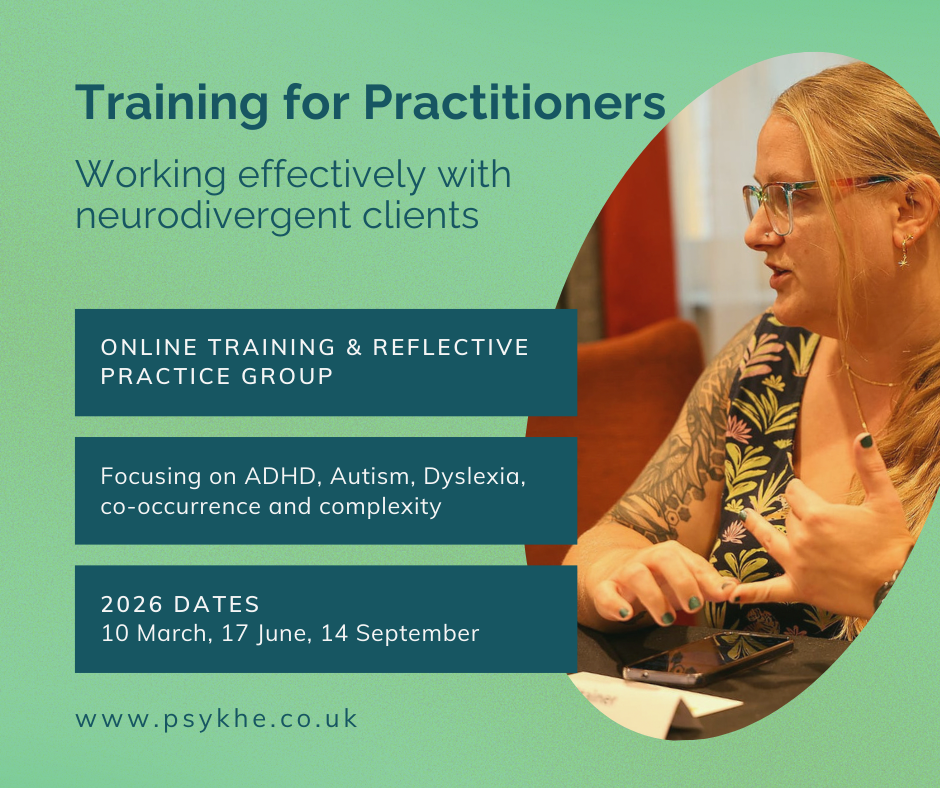
This 3-hour training is designed for counsellors, coaches, therapists and wellbeing professionals who want to deepen their understanding of neurodivergence and feel more confident, informed and adaptable in their work. Whether you are new to this area or looking to refine and expand your existing practice, this session offers a rich blend of knowledge, reflection and practical tools to support meaningful, attuned work with neurodivergent clients.
We explore the key neurodivergent profiles you’re most likely to encounter in practice—including ADHD, autism and dyslexia—while also considering the complexity and co-occurrence that often shape people’s lived experience.
You’ll gain a clearer understanding of how neurodivergence may influence communication, processing, emotional regulation, identity and therapeutic engagement.
The training is a mix of delivered content, guided discussion and reflective practice, creating space not just to learn but to think, question, adapt and connect theory with your own therapeutic or coaching style. Along the way, you’ll learn practical strategies to help you tailor your approach, make your practice more accessible, and build relationships that feel safe, collaborative and genuinely supportive for neurodivergent clients.
By the end, you’ll leave with increased confidence, a stronger skillset and a deeper appreciation of the diversity within neurodivergence—along with practical, immediately usable tools to enhance your work.